

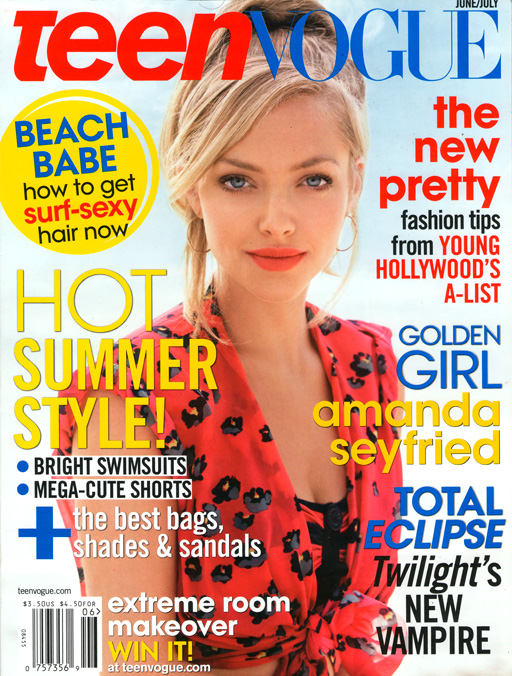


Firstly, I notice that all of the magazine covers
contain girly colours such as different shades of pinks and reds and generally
light, pastel colours which give off feminine connotations. This makes strong
referral to who the target audience are and in this case, the magazines are
aimed at teenage girls and this is strongly evident because of the pull quotes
the covers contain and how all of the models (who are famous actresses or
singers) featured are female. The reason why well known females have
been used to model on the covers is because they could be icons to some girls -
people that they look up to for the way they live their lives and what their
style is like for instance.
Examples of pull quotes
featured in a couple of the magazines are "My face made me an
outcast" and “She pulled – and spent the first night snogging in our bed”.
These are examples of situations featured in the magazine which involve girls,
although the second one strongly shows a male is involved in it too. For
instance, the first pull quote talks about something which is personal and
would aim to gain empathy from the reader. The second one is a story coming
from the boyfriend’s point of view, so this may attract some male readers too,
and alert them to people's experiences. The stories are therefore controversial
and are from real life events. This is something teenage magazines include, and
their purposes are to enable teenagers to relate to them and to gain interest
from readers. Also, they may have been included to show that each magazine has
a variety of conventions to offer to readers and that they do not specialise in
only one type of article, so they are getting a good package for the money they
are spending.
Shout, Cosmo Girl and Sugar
contain some identifiable elements of serif text on their covers. Serif text is
often referred to on magazines which portray elegance and femininity, so this
style of font may have been included to enhance who the target audience is of
them. Bliss and Teen Vogue do contain elements of serif text, but this is in
much smaller amounts. For example, the only text I can see which displays serif
are the words "Cher" and "sweet summer style" on the Bliss
cover and "Vogue" which is a part of Teen Vogue's title.
All of the magazines
contain plugs which aim to directly gain the reader's attention with Cosmo Girl
and Sugar using second person pronouns and Bliss, Teen Vogue and Shout using
language which is interrogative and speaking more from an open and objective
point of view. For example, Sugar's cover includes "How do you
score?" while Shout's cover includes "Want glossy, gorgeous hair?”
Either way, the magazines are aiming to connect with the readers by posing
these questions despite which pronouns are used.
Also, all magazines selected for this analysis contain images on their
front covers, apart from Teen Vogue. Bliss, Shout and Sugar all contain
pictures of clothing items and/or accessories and Cosmo Girl contains a picture
of a boy band in the top right hand corner. Bliss, Shout and Sugar have
included clothing items and accessories because they know that the target
audience tend to take interest in their appearances and trends and styles can
be a significant influence in their lives. Cosmo Girl may have also included
the picture of the boy band on their cover to show that the magazine also
underlines aspects of music as well as celebrity gossip and real life stories.
Although Teen Vogue does not contain pictures of clothing items or accessories,
there are puffs included on the cover which say "Bright swimsuits"
and "Mega-cute shorts" so this suggests that the readers have to look
inside to find out what these items are like in terms of their images.
It is clear that all 5 magazine covers contain the most information
in their left thirds and this is because the aim is to include as much
information as possible which would be of interest to readers when they see the
magazines on the shelves of shops.

No comments:
Post a Comment